
30 to 45 minutes
Varies by depth, from none through to several days of visible peeling
Visible once peeling completes, typically within a week
Often a series for pigment and texture concerns, discussed at consultation
Light peels every 4 to 6 weeks, deeper peels spaced further apart
None required
Skin changes gradually and then all at once. Sun exposure accumulates over years without appearing to do much, and then the tone looks uneven in photographs, texture catches the light differently, and the products that used to work stop making a visible difference.
Chemical peels at Viva Vitality MedSpa in Lakeland, FL, address that at the surface where it sits. A solution of exfoliating acids removes the damaged outer layers so healthier skin comes through, and the depth is chosen for your skin and your concerns rather than applied as a standard treatment.
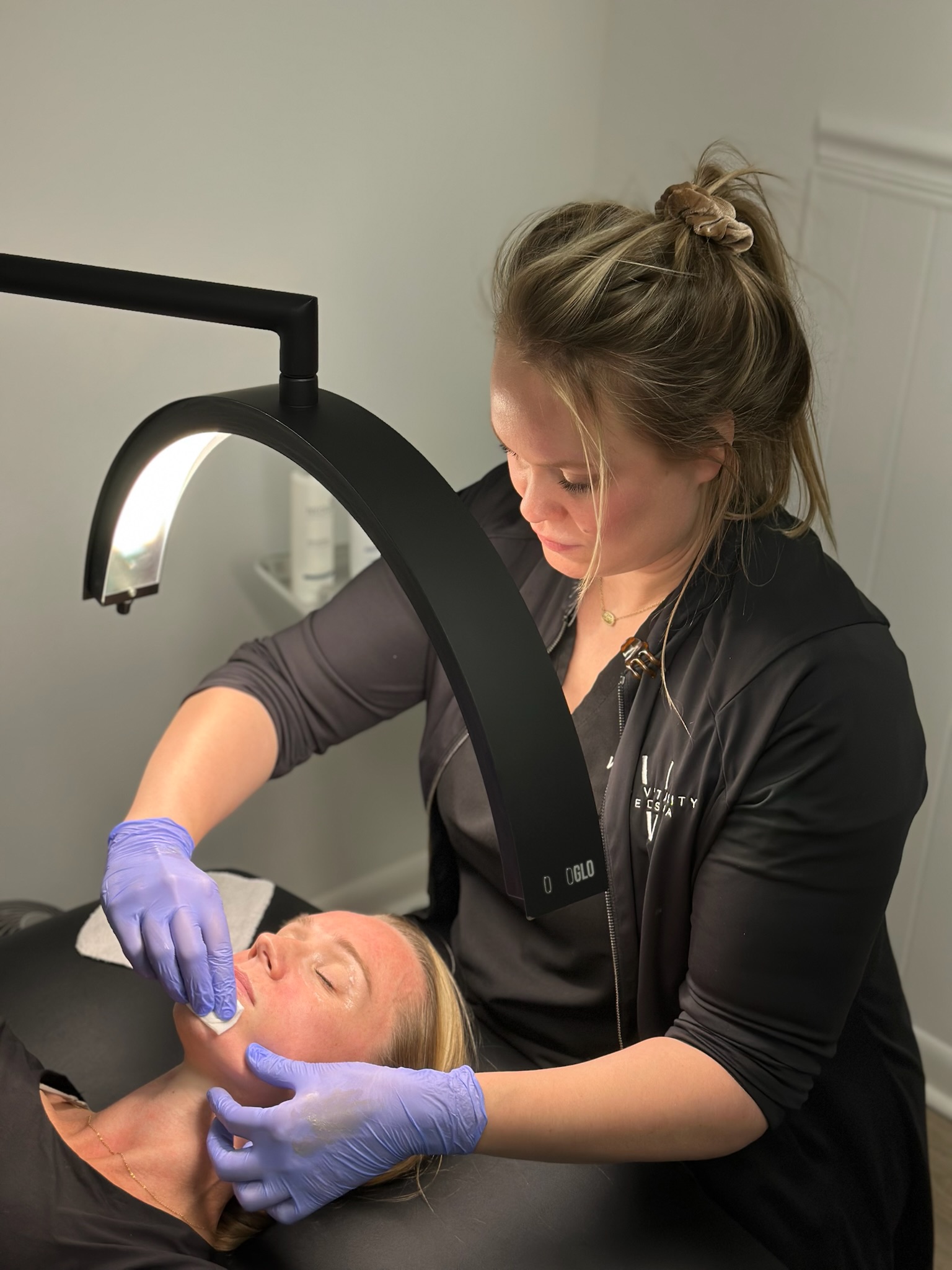
A chemical peel is a controlled exfoliation. A solution of acids is applied to the skin for a set period, loosening the bonds between dead surface cells so those layers shed and reveal the skin underneath. It also prompts collagen production during healing, which is where the improvement in texture comes from.
The important variable is depth. Light peels work within the outermost layer and ask almost nothing of your schedule. Medium peels reach further and produce more change alongside several days of visible peeling. Which is appropriate depends on what you are treating, your skin type, and how much recovery you can accommodate.
At Viva Vitality, that decision is made at consultation rather than assumed. Starting lighter and building is usually the right approach, particularly for a first peel, and it is considerably easier to go deeper next time than to undo a peel that was too aggressive.
The solution is applied to clean, prepared skin and left for a controlled period before being neutralized or allowed to self-neutralize depending on the formulation. During that time, the acids break down the bonds holding dead cells to the surface.
Over the following days, those layers shed. Depending on depth, that ranges from barely perceptible flaking to visible peeling across several days. Underneath, the skin that comes through has had its uppermost damaged layers removed, which is what produces the change in tone and clarity.
The second effect develops more slowly. Controlled injury to the skin prompts collagen production during healing, so texture and firmness continue improving for weeks after the peeling itself has finished. This is why a series often outperforms a single treatment for textural concerns.

Peels are one of the more adaptable treatments available, which is both their advantage and the reason the consultation matters. The same treatment can be a maintenance facial or a genuine resurfacing depending on how it is set.
Reduces the appearance of fine lines by removing damaged surface layers and prompting collagen renewal.
Evens pigmentation and fades sun damage across the whole treated area rather than spot by spot.
Helps soften shallow textural scarring and the discoloration left behind after breakouts.
Stimulates collagen during healing, which continues improving texture and firmness for weeks afterward.
Peels are adjusted from light to medium based on your skin, your concerns, and the downtime you can accommodate.
The same approach can be applied to the back, shoulders, chest, and hands, where sun damage often accumulates unnoticed.
Peels are most often performed on the face, though anywhere that accumulates sun damage or textural change can be treated. Body areas heal more slowly than facial skin, so depth is adjusted accordingly.
The most common treatment area, producing an even result across the whole face.
Addresses sun damage and texture across a broad area.
The largest area of most treatments and where pigment change is often most visible.
Refines texture and reduces the appearance of congestion and enlarged pores.
Treated at lighter depths, as the skin here is thinner and more reactive.
Softens fine lines and improves texture around the lips.
A common site for pigment change, particularly with melasma.
Addresses congestion and post-acne discoloration.
Improves texture and tone along the lower face.
Treated conservatively, as neck skin is thinner and slower to heal than the face.
Frequently treated alongside the face, since the chest often shows more accumulated sun damage.
Useful for congestion and post-acne marks in an area difficult to treat at home.
Addresses sun damage on skin that is exposed regularly and rarely protected.
Treats age spots and texture on skin that reveals age early.
Improves rough texture and sun damage on the forearms.
Peels work at the surface and just beneath it, which is what defines their range. Concerns rooted in accumulated sun damage, pigment, congestion, and surface texture respond well; anything structural needs a different approach.
Softens early lines by removing damaged layers and prompting collagen renewal
One of the clearest indications, addressing photodamage across the full treated area.
Fades discrete pigmented lesions alongside general tone correction.
Improves areas of excess pigment, with depth and formulation chosen for your skin type.
May be treated in carefully selected patients. Melasma is heat- and inflammation-sensitive and can worsen with aggressive treatment, so it requires conservative depth, close assessment, and realistic expectations about recurrence.
Produces a more consistent complexion by treating the whole area uniformly.
Restores clarity by clearing the buildup that scatters light unevenly.
Smooths surface irregularity that makes skin feel and look coarse.
Certain formulations help clear congestion and reduce active breakouts.
Improves shallow textural scarring, while deeper atrophic scars need a resurfacing treatment.
Addresses the discoloration left behind after breakouts have cleared.
Reduces how prominent pores appear by improving surrounding skin quality.
Clears the buildup contributing to blocked pores.
Some formulations help regulate surface oil without stripping the skin.
Restores the light reflection that accumulated damage dulls over time.
Addresses change while it is still confined to the surface.
Body peels can improve the rough, bumpy texture on the arms and thighs.
Most people are candidates for some depth of peel, which is the useful thing about them. The question is usually which depth rather than whether, and that is determined by your skin type, your concerns, and how much visible peeling you can accommodate.
Skin tone is a genuine consideration. Deeper skin tones carry a higher risk of post-inflammatory hyperpigmentation with any treatment that removes tissue, which is why depth is chosen conservatively and a pre-treatment regimen is sometimes recommended first. This is assessed honestly rather than worked around.
Treatment should be delayed if you have an active infection, cold sore outbreak, open wound, or sunburn in the treatment area, or if you are experiencing an active flare of rosacea or eczema. Peels are avoided during pregnancy depending on the formulation, and recent isotretinoin use requires waiting. Your suitability is confirmed by Brenda Baxter, MSN, NP-C, or a member of the clinical team at consultation.
Your appointment begins with cleansing and preparing the skin, followed by the peel solution applied in layers. Most people describe a warming or tingling sensation that builds and then settles, and a fan is usually provided for comfort. The whole treatment takes 30 to 45 minutes.
Afterward, the skin often looks slightly flushed, similar to mild sun exposure, and feels tight. Depending on depth, peeling begins anywhere from the second to the fourth day and continues for several days. Lighter peels may produce only faint flaking; medium peels produce visible sheeting.
The most important thing during that window is leaving the skin alone. Peeling skin should be allowed to shed on its own, and pulling at it is the most common cause of scarring and pigment change after an otherwise straightforward treatment.
Preparation and aftercare both affect your result more than the peel itself does, particularly where pigment is the concern. The points below apply to either side of your appointment.
The brightness and clarity from a single peel typically last several weeks to a few months, depending on depth and on what your skin is exposed to afterward. Sun exposure is the main variable, which is why the sunscreen advice is not a formality on this treatment.
Textural improvement from collagen stimulation lasts longer, and it accumulates with repeated treatment. Most patients addressing pigment or texture do a series rather than a single peel, then move to maintenance at longer intervals once they have reached the result they wanted.
Peels resurface the skin surface. Where your concerns extend deeper, or where you want to maintain results between peels, the treatments below are the ones most often combined with them at Viva Vitality.
The treatments below work at different depths and require different amounts of recovery. Which suits you depends on how much change you need and how much visible downtime you can accommodate.
Treatment | How It Works | Typical Downtime | Best For |
Light Chemical Peel | Acids exfoliate the outermost layer | Minimal to none | Dullness, mild texture, and maintenance |
Medium Chemical Peel | Acids reach deeper into the epidermis | Several days of peeling | Pigment, sun damage, and more established texture |
Dermaplaning | Manual exfoliation with a surgical blade | None | Dead skin, peach fuzz, and immediate smoothness |
SkinPen Microneedling | Micro-injuries stimulate collagen at depth | 1 to 2 days | Texture, scarring, and skin quality |
IPL Photofacial | Light energy targets pigment and vessels | Minimal | Sun spots, redness, and vascular concerns |
A peel is only as good as the assessment behind it. Choosing the wrong depth for your skin type is how a straightforward treatment turns into a pigment problem, which is why the consultation matters more here than the product does.
Viva Vitality MedSpa offers chemical peels to patients throughout Lakeland and the surrounding Central Florida communities. Our South Florida Avenue location sits between Lake Hollingsworth and Lake Morton, within easy reach of Plant City, Winter Haven, and the Tampa area.

A typical session lasts about 30 to 45 minutes from cleansing through to the final application. There is no numbing period beforehand, so the appointment time is the whole commitment. Your first visit takes slightly longer, as it includes an assessment of your skin and a discussion of which depth is appropriate.
Cost depends on the depth and formulation used, since a light maintenance peel is priced differently from a medium-depth treatment. Because pigment and texture concerns often need a series rather than a single treatment, it is worth discussing the cost of a course at your consultation rather than a single visit. Payment plans are available through PatientFi and CareCredit.
The difference is how far into the skin the solution reaches, and it determines both the result and the recovery. Light peels work within the outermost layer, produce subtle brightening, and require almost no downtime, which makes them suitable for regular maintenance. Medium peels reach further into the epidermis, address pigment and texture more meaningfully, and involve several days of visible peeling.
Deep peels reach the dermis and require significant recovery and medical supervision, and they are used far less often now that other resurfacing options exist. At Viva Vitality, your depth is selected at consultation, and starting lighter and building is usually the right approach for a first treatment.
Usually, though how much varies considerably with depth. Light peels may produce only faint flaking that is barely noticeable, while medium peels produce visible sheeting across several days. Peeling generally begins on the second to fourth day and finishes within about a week. The important thing is to let it shed on its own rather than pulling at it.
Before treatment, avoid sun exposure for two weeks, stop retinoids and exfoliating acids five to seven days beforehand, and reschedule if you have sunburn or an active breakout of cold sores. Afterward, do not pick or pull at peeling skin under any circumstances, avoid heat and heavy sweating for a few days, and wear broad-spectrum SPF 30 or higher every day. Newly resurfaced skin pigments readily, so sun protection matters more than usual for several weeks.
Light peels can generally be repeated every four to six weeks, which is the rhythm most patients use for maintenance. Medium peels are spaced considerably further apart to allow full recovery between treatments. If you are working through a specific concern such as pigment or acne scarring, your provider will set a schedule for the series and then move you to maintenance once you have reached the result you wanted.
Often yes, with the right formulation and a conservative depth. Patients with rosacea, eczema, or generally reactive skin can frequently tolerate a light peel well, though active flares should be allowed to settle first. Mention any history of reaction to products or treatments at your consultation so the formulation can be selected accordingly, and a test patch is sometimes recommended.
They can be, with appropriate depth and formulation. It is worth being straightforward that any treatment removing tissue carries a higher risk of post-inflammatory hyperpigmentation in deeper skin tones, and that risk rises with depth. Lighter peels and specific formulations are generally the safer route, and a pre-treatment regimen is sometimes recommended beforehand. Where a peel is not the right choice, you will be told so and offered an alternative rather than treated anyway.
Peels are avoided over active infections, cold sore outbreaks, open wounds, and sunburn, and during active flares of rosacea or eczema. Recent isotretinoin use requires a waiting period, and certain formulations are avoided during pregnancy and breastfeeding. A history of keloid scarring also requires careful assessment. Your full history is reviewed before treatment rather than afterward.
Most patients notice brighter, clearer skin with more even tone once peeling completes, generally within a week. Texture continues improving for several weeks afterward as collagen renews. A single peel produces a visible refresh; meaningful change to established pigment or texture usually takes a series. Your provider will give you a realistic expectation at consultation based on your skin and what you are treating.
The most useful thing a consultation does for this treatment is establish which depth suits your skin, because that decision determines both your result and your recovery. It will also tell you honestly whether a peel is the right choice for what you want to change.
Call 863-450-4060 or book a consultation at 2015 South Florida Ave, Lakeland, FL 33803. We are open Monday through Wednesday, 9 am to 5 pm, Thursday 9 am to 6 pm, and Friday 8:30 am to 3 pm.
Home
About
Services
Skin
Face
Neurotoxins
Botox®
Dermal Fillers
Biostimulators
Energy & Laser
Body
Hair Restoration
Wellness
Private Injector Training
Conditions We Treat
Treatments By Decade
Treatments By Body Area
Signature Treatments
Blog
Rewards
Before & After
Shop
Payment Plans
Memberships
Contact